In the rapidly evolving world of sports technology, few subjects generate as much curiosity—and confusion—as betting odds. Whether you are a casual fan exploring a sportsbook app for the first time or a developer building a platform that integrates real-time wagering data, understanding how odds function is essential. Odds are not arbitrary numbers; they are sophisticated financial instruments that reflect probability, market sentiment, and the bookmaker’s margin. This article breaks down the mechanics of sports betting odds, the formats they take, and the underlying math that powers them.
The Fundamental Concept: Probability and Payouts
At their core, sports betting odds serve two intertwined purposes. First, they indicate the implied probability of a particular outcome. Second, they determine how much a bettor stands to win relative to their stake. These two functions are mathematically linked. The higher the implied probability, the lower the potential payout, and vice versa.
Bookmakers employ teams of analysts, data scientists, and risk managers to set odds that accurately reflect the likelihood of an event while ensuring a profit margin for the house. This margin, often called the vigorish or vig, is the commission the sportsbook charges for accepting a wager.
The Three Primary Odds Formats
Different regions around the world use different conventions for expressing odds. A well-designed betting platform must handle all three formats seamlessly, as user preference varies by geography and culture.
1. Decimal Odds
Decimal odds are the standard in Europe, Australia, and Canada. They are expressed as a single number, such as 2.50 or 1.75. The decimal figure represents the total return on a winning bet, including the original stake.
- Formula: Payout = Stake × Decimal Odds
- Example: A $100 bet at 2.50 returns $250 total ($150 profit + $100 stake).
- Implied Probability: 1 ÷ Decimal Odds × 100
Decimal odds are favored in technical contexts because they simplify calculations and integrate cleanly into algorithmic trading systems.
2. Fractional Odds
Fractional odds, traditional in the United Kingdom and Ireland, are written as a fraction, such as 5/2 or 1/3. The first number represents the potential profit, and the second represents the stake required.
- Formula: Profit = Stake × (Numerator ÷ Denominator)
- Example: A $100 bet at 5/2 yields $250 profit, plus the $100 stake returned.
- Implied Probability: Denominator ÷ (Numerator + Denominator) × 100
Fractional odds can be less intuitive for newcomers, but they remain deeply embedded in British racing and football culture.
3. American Odds (Moneyline)
American odds dominate the United States market. They are expressed as either a positive or negative number, typically in increments of 100.
- Positive Odds (+): Indicate underdogs. A +200 line means a $100 stake wins $200 profit.
- Negative Odds (−): Indicate favorites. A −150 line means you must stake $150 to win $100 profit.
- Implied Probability (Positive): 100 ÷ (Odds + 100) × 100
- Implied Probability (Negative): |Odds| ÷ (|Odds| + 100) × 100
For developers, American odds require careful parsing because the sign carries critical meaning. A simple string comparison or numeric conversion without sign handling will produce incorrect implied probabilities.
Converting Between Odds Formats
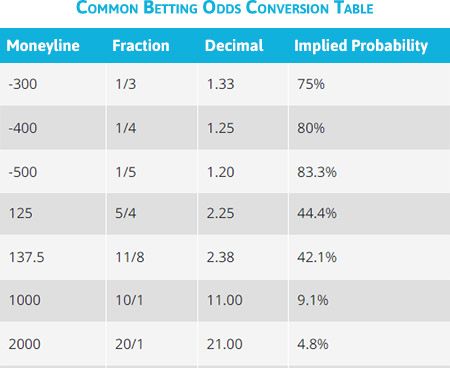
Interoperability is a key concern for any platform aggregating odds from multiple sources. The table below provides a quick reference for converting between the three formats.
| 1.50 | 1/2 | −200 | 66.67% |
| 2.00 | 1/1 | +100 | 50.00% |
| 2.50 | 3/2 | +150 | 40.00% |
| 3.00 | 2/1 | +200 | 33.33% |
| 4.00 | 3/1 | +300 | 25.00% |
Notice that the implied probabilities in the table do not sum to 100% when paired against an opposing outcome. This discrepancy is by design and reflects the bookmaker’s margin.
The Bookmaker’s Margin: Why the House Always Wins
Consider a tennis match between two evenly matched players. A fair market would offer 2.00 decimal odds on each player, implying a 50% chance for each. However, a real sportsbook might offer 1.90 on each side. The implied probabilities are now 52.63% each, summing to 105.26%. That extra 5.26% is the vigorish.
The formula for calculating the margin is straightforward:
- Margin = (1 ÷ Decimal Odds A) + (1 ÷ Decimal Odds B) − 1
For a two-outcome market, a margin between 2% and 5% is typical. Markets with higher liquidity, such as NFL point spreads or Premier League match winners, often feature tighter margins. Niche markets, such as prop bets or lower-division leagues, carry higher margins to compensate for increased risk and lower trading volume.
Odds Movement and Market Efficiency
Odds are not static. They shift continuously in response to incoming information: injuries, weather conditions, lineup changes, and—most significantly—the volume and direction of bets placed by the public and by sharp bettors.
When a sportsbook receives a disproportionate amount of money on one side, it may adjust the odds to encourage action on the opposite side, balancing its exposure. This process is known as moving the line. In efficient markets, odds converge toward the true probability of an outcome as more information is priced in.
For technologists, this dynamic environment presents real-time data challenges. Odds feeds update multiple times per second, and latency can mean the difference between a profitable arbitrage opportunity and a loss. Modern sportsbooks rely on low-latency APIs, WebSocket connections, and in-memory databases to process and distribute odds changes instantly.
Key Takeaways for Technologists and Bettors
Mastering the mechanics of sports betting odds is not merely an exercise for gamblers. It is a lesson in probability theory, market dynamics, and real-time data engineering—skills that resonate far beyond the sportsbook and into the broader technology landscape.
Leave a Reply