Baccarat occupies a unique position in the casino world. It is simultaneously one of the oldest card games in continuous play and one of the most misunderstood by newcomers. Its reputation for elegance, high stakes, and quiet intensity often obscures a fundamental truth: the rules are remarkably simple. In many respects, baccarat is easier to learn than blackjack or poker. The complexity that players perceive usually stems from the betting interface and the game’s terminology, not the underlying mechanics.
This guide breaks down how baccarat actually works, from the dealing of the cards to the resolution of a hand, and then examines the major variations that define the game in different markets and platforms.
The Core Objective
At its foundation, baccarat is a comparison game. Two hands are dealt: the Player hand and the Banker hand. The objective is to bet on which hand will finish closer to a total of nine. Players do not make decisions that affect the outcome of the deal. There are no hit-or-stand choices, no doubling down, and no splitting. The entire game is governed by a fixed set of drawing rules, which means the outcome of every round is determined by probability and the shuffle rather than by player strategy.
This is the critical distinction that separates baccarat from most other table games. The player’s only decision is where to place the bet before the cards are dealt.
The Three Primary Bets
Every standard baccarat round offers three wagering options, each with its own payout structure and house edge.
- Player bet: Pays even money (1:1). Wins if the Player hand finishes with a higher total than the Banker hand.
- Banker bet: Pays even money minus a commission, typically 5%. Wins if the Banker hand finishes higher.
- Tie bet: Pays 8:1 or 9:1 depending on the table. Wins if both hands finish with identical totals.
The commission on the Banker bet exists because the Banker hand wins slightly more often than the Player hand. The drawing rules, which are not symmetrical, give the Banker a statistical advantage of roughly 1.06% after commission, compared to about 1.24% for the Player bet. The Tie bet, despite its attractive payout, carries a house edge that commonly exceeds 14%, making it the least favorable option on the table.
Card Values and Hand Totals
Baccarat uses a modified counting system that differs from most card games. Understanding it takes only a moment.
| Ace | 1 |
| 2 through 9 | Face value |
| 10, Jack, Queen, King | 0 |
When a hand’s total exceeds nine, only the second digit is used. This is the defining rule of baccarat. A hand consisting of a 7 and a 6 totals 13, which reduces to 3. A hand of 9 and 8 totals 17, which reduces to 7. The highest possible hand is a natural 9, followed by a natural 8. If either hand is dealt a natural, the round typically ends immediately without further draws, provided the rules of the specific variant allow it.
The Drawing Rules
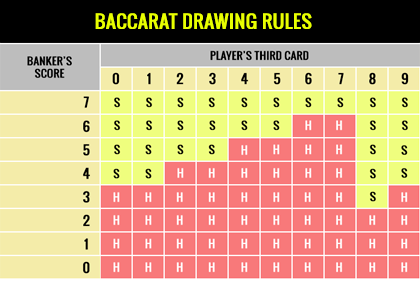
The dealing process follows a strict protocol. Two cards are dealt to the Player hand and two to the Banker hand. If either hand holds a natural 8 or 9, the round is resolved. Otherwise, a third card may be drawn according to a fixed table of conditions.
The Banker’s decision table is the most intricate element of the game, but it is executed automatically by the dealer or the software. Players never need to memorize it. In practice, the rules are designed to produce a near-optimal outcome for the Banker hand, which is precisely why the commission exists.
Major Game Variations
Baccarat has evolved into several distinct formats, each shaped by regional preferences and, more recently, by digital distribution.
Punto Banco
Punto Banco is the dominant form in North America, the United Kingdom, and most online casinos. In this variation, the drawing rules are mandatory and the house acts as the Banker. The terms punto and banco refer to the Player and Banker bets respectively. There are no decisions to make beyond the wager itself, which is why Punto Banco is often described as the purest form of the game.
Chemin de Fer
Chemin de Fer, French for “railway,” is a traditional European variant in which players take turns acting as the Banker. The banker position rotates around the table, and the banker—not the house—covers the opposing bets. The banker also has discretion over whether to draw a third card in certain situations, introducing a strategic element absent from Punto Banco. This variant appears less frequently in modern casinos but remains culturally significant.
Baccarat Banque
Similar in structure to Chemin de Fer, Baccarat Banque keeps the bank in the hands of a single player for an extended period rather than rotating it every hand. The banker may also be required to cover multiple Player hands simultaneously. This format is rare in contemporary play but persists in select European venues.
Mini-Baccarat
Mini-Baccarat is a scaled-down version of Punto Banco designed for smaller tables and faster play. The rules are identical, but the table is smaller and the minimum bets are lower. The dealer handles all cards, and the game moves quickly. It is frequently the entry point for newcomers and the most common format in online lobbies.
No-Commission Baccarat
Some casinos remove the 5% commission on the Banker bet and adjust the payout structure instead. A common approach pays the Banker bet 1:1 unless the Banker wins with a total of 6, in which case the payout is reduced to 0.5:1. This variation simplifies the visual accounting for players but typically carries a slightly higher house edge on certain outcomes.
Speed and Live Dealer Baccarat
Digital platforms have produced variations that prioritize pace and accessibility. Speed Baccarat removes the betting window between rounds, compressing each hand into a shorter cycle. Live dealer baccarat streams a real table with a human dealer, restoring the social atmosphere of a physical casino while retaining the convenience of online access. Some operators add side bets such as Player Pair, Banker Pair, or Perfect Pair, though these carry significantly higher house edges.
Why the Game Endures
Baccarat’s appeal lies in its clarity. The rules are fixed, the odds are published, and the only variable under the player’s control is the bet. For players who value simplicity and transparency over strategic decision-making, it remains an efficient and enduring choice. For those approaching it for the first time, the most important takeaway is that the game is far less complicated than its reputation suggests. Learn the three bets, understand the card values, and the rest follows automatically.
Leave a Reply