Blackjack is one of the few casino games where skill, strategy, and probability can genuinely influence the outcome of every hand. Unlike purely chance-driven games such as roulette or slots, blackjack rewards players who understand the rules, master basic strategy, and manage their bankroll with discipline. For beginners, the learning curve can feel steep, but the core concepts are refreshingly simple once broken down. This guide covers the essential blackjack fundamentals every new player should know before sitting down at a table, whether in a physical casino or an online environment.
What Is Blackjack?
Blackjack is a comparing card game played between one or more players and a dealer. The objective is straightforward: build a hand whose total value is closer to 21 than the dealer’s hand, without exceeding 21. A hand that exceeds 21 is called a bust, and it results in an automatic loss regardless of what the dealer holds.
Each card carries a specific point value:
- Numbered cards (2 through 10) are worth their face value.
- Face cards — Jack, Queen, and King — are each worth 10 points.
- Aces are flexible: they count as either 1 or 11, whichever benefits the hand more.
A hand containing an Ace valued at 11 is called a soft hand. If the Ace must drop to 1 to prevent a bust, the hand becomes hard. Understanding this distinction is critical because it directly affects how you should play certain hands.
The Natural Blackjack
A blackjack — also called a natural — occurs when your first two cards are an Ace and any ten-value card. This is the strongest possible starting hand and typically pays out at 3:2, meaning a $10 bet returns $15 in profit. It is important to note that a blackjack beats a total of 21 made with three or more cards. If both you and the dealer hold a natural, the hand is a push, and your bet is returned.
How a Round of Blackjack Unfolds
Understanding the flow of a hand helps beginners anticipate each decision point. The sequence generally proceeds as follows:
Each player’s turn moves clockwise, and you may act only on your own hand. This is one of the features that makes blackjack appealing — your decisions matter, but they do not interfere with other players’ outcomes.
Your Core Playing Options
When it is your turn, you have several actions available. Mastering what each one does is fundamental.
- Hit: Request an additional card to increase your hand total.
- Stand: End your turn and keep your current total.
- Double Down: Double your original bet, receive exactly one more card, and then stand. This is typically reserved for strong starting hands.
- Split: When your first two cards are a pair, you may split them into two separate hands, each with its own bet.
- Surrender: Forfeit half your bet and exit the hand. Not all tables offer this option.
- Insurance: A side bet that pays 2:1 if the dealer has a blackjack. Generally considered a poor bet for beginners.
The Dealer’s Fixed Rules
Unlike players, the dealer has no choices. The dealer must follow rigid house rules, typically drawing until reaching a total of 17 or higher. Some tables require the dealer to hit on a soft 17, while others require a stand. This rule subtly shifts the house edge, so it is worth checking before you play.
| 16 or lower | Must hit |
| 17 or higher | Must stand |
| Soft 17 | Depends on table rules |
Because the dealer cannot make strategic decisions, your advantage comes from knowing when to hit, stand, double, or split based on probability — not intuition.
Why Basic Strategy Matters
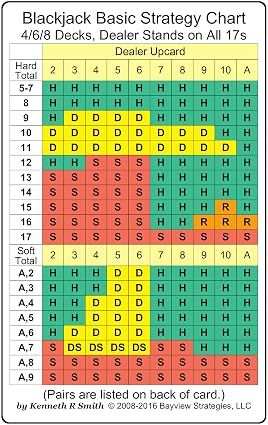
Basic strategy is a mathematically derived set of decisions that tells you the optimal play for every possible hand combination against every possible dealer upcard. It does not guarantee wins, but it reduces the house edge to roughly 0.5% when applied correctly. Beginners who ignore basic strategy often give the house an edge of 2% or more.
Memorizing the full basic strategy chart takes time, but the payoff is substantial. Start with the most common scenarios — hard totals, soft totals, and pairs — and build your knowledge incrementally. Many online casinos offer free play modes where you can practice without risking real money.
Bankroll Management for Beginners
Even the best strategy cannot overcome a poorly managed bankroll. Consider these principles:
- Set a session budget and never exceed it.
- Bet a small, consistent percentage of your total bankroll — typically 1% to 2% per hand.
- Avoid chasing losses; variance is a normal part of the game.
- Treat blackjack as entertainment, not as a reliable income source.
Common Beginner Mistakes to Avoid
New players frequently make predictable errors that erode their edge. Watch out for these:
Final Thoughts
Blackjack rewards preparation. Learn the card values, understand your options, memorize basic strategy, and manage your money with discipline. Do these things, and you will enjoy the game far more than the average beginner — and you will give yourself the best possible chance of walking away ahead. The house edge exists, but in blackjack, unlike most casino games, the informed player can shrink it dramatically.
Leave a Reply