Roulette remains one of the most recognizable and enduring games in any casino, physical or digital. Its appeal lies in a rare combination: simple rules, rapid rounds, and a broad spectrum of betting options that reward both casual players and seasoned strategists. For anyone stepping up to the table for the first time, or for developers building a roulette module into a gaming platform, understanding the underlying mechanics is essential. This guide breaks down the rules, the layout, the bet types, and the gameplay flow in clear, practical terms.
The Core Premise
At its heart, roulette is a game of chance built around a spinning wheel and a small ball. The dealer, or croupier, spins the wheel in one direction and the ball in the opposite direction. As the ball loses momentum, it drops into one of the numbered pockets on the wheel. Players place bets on where they believe the ball will land, and payouts are determined by the type of bet and the odds associated with it.
The game is governed by two main variables: the wheel type and the betting layout. Both influence the house edge, the available wagers, and the overall player experience.
European vs. American Wheels
The first thing to identify at any roulette table is the wheel variant, because it directly affects the odds.
- European Roulette: Features a single zero (0), giving 37 total pockets. The house edge is approximately 2.7%.
- American Roulette: Features both a single zero (0) and a double zero (00), giving 38 total pockets. The house edge rises to roughly 5.26%.
- French Roulette: Also uses a single-zero wheel but includes special rules such as La Partage and En Prison, which can reduce the house edge on even-money bets to about 1.35%.
For players seeking the best mathematical value, the European or French wheel is almost always the preferred choice.
The Betting Layout
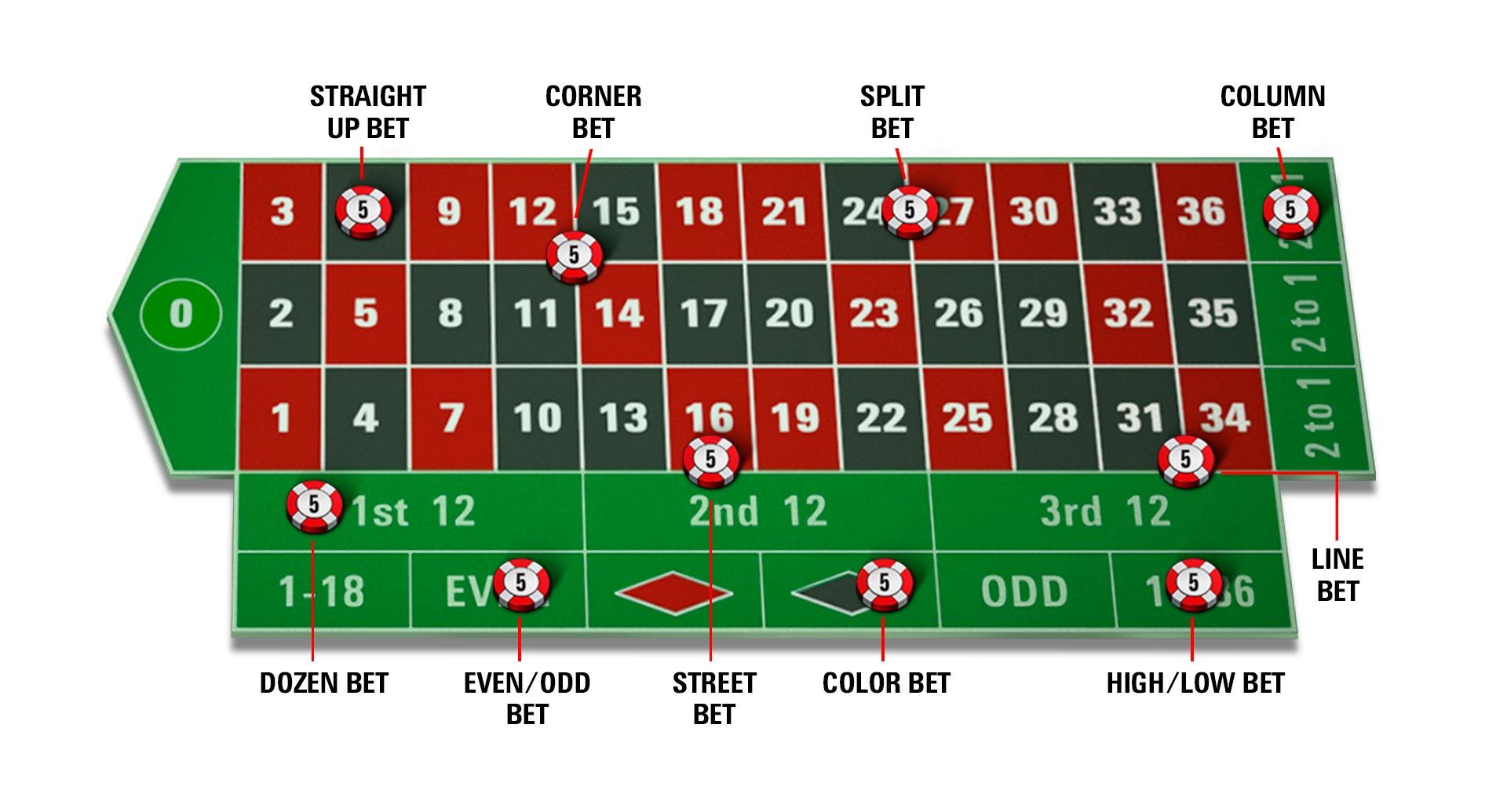
The roulette table layout mirrors the wheel’s numbering but organizes it into a grid that accommodates dozens of bet combinations. The layout is divided into two broad categories: inside bets and outside bets.
Inside Bets
Inside bets are placed on the numbered grid itself and generally offer higher payouts with lower probabilities of winning.
| Straight Up | A single number | 35 to 1 |
| Split | Two adjacent numbers | 17 to 1 |
| Street | Three numbers in a row | 11 to 1 |
| Corner | Four numbers in a square | 8 to 1 |
| Six Line | Two adjacent rows of three | 5 to 1 |
Outside Bets
Outside bets are placed on the perimeter of the layout and cover larger groups of numbers. They pay less but win more frequently.
- Red or Black: Bets on the color of the winning pocket. Pays 1 to 1.
- Odd or Even: Bets on the parity of the number. Pays 1 to 1.
- Low or High: Bets on numbers 1–18 or 19–36. Pays 1 to 1.
- Dozens: Bets on 1–12, 13–24, or 25–36. Pays 2 to 1.
- Columns: Bets on one of the three vertical columns. Pays 2 to 1.
How a Round Unfolds
Despite the variety of bets, the gameplay sequence is consistent and easy to follow.
Special Rules Worth Knowing
Certain roulette variants include rules that change the outcome of a spin involving zero.
- La Partage: On even-money bets, if the ball lands on zero, the player loses only half the wager.
- En Prison: On even-money bets, if zero appears, the wager is held for the next spin rather than lost outright.
- Surrender: An American variant rule that allows players to forfeit half their even-money bet when zero or double zero hits.
Strategy and Probability
It is important to understand that roulette is a game of independent events. Each spin is statistically unrelated to the one before it, which means no system can alter the underlying house edge. Strategies such as the Martingale, Fibonacci, or D’Alembert systems manage bet sizing and bankroll exposure, but they do not change the mathematics of the wheel. Players and operators alike should treat roulette as entertainment, not as a predictable income source.
Final Thoughts
Roulette rewards players who understand its structure. Knowing the difference between wheel variants, recognizing the payout table, and grasping the flow of a round transforms the experience from guesswork into informed play. Whether implemented in a land-based casino or a digital platform, the rules remain elegantly simple—and that simplicity is precisely what has kept roulette spinning for more than two centuries.
Leave a Reply