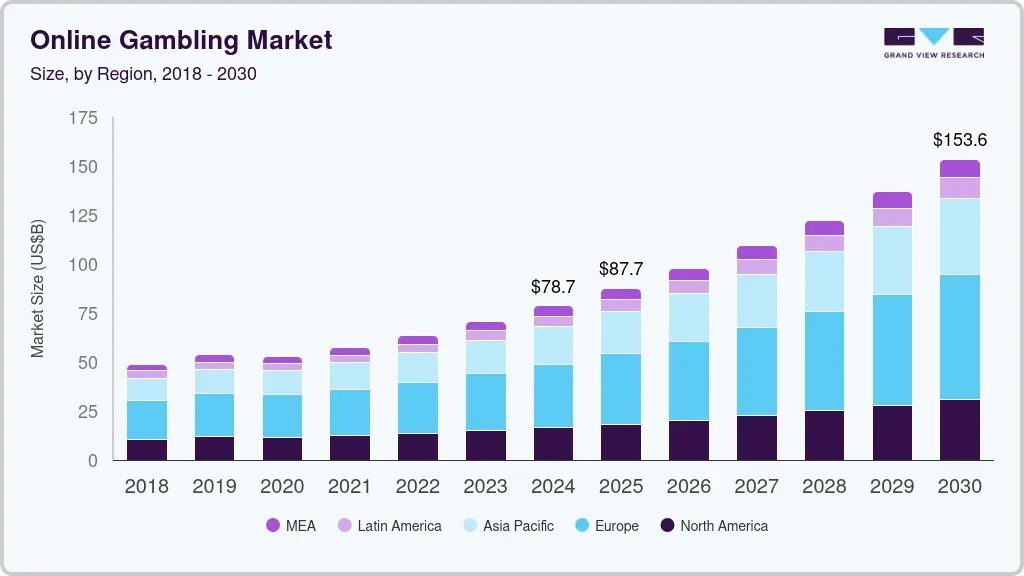
The online gambling sector has evolved from a peripheral novelty into a mature, technology-driven industry generating hundreds of billions of dollars in annual revenue. What was once defined by clunky browser-based casino lobbies and rudimentary sportsbooks has become a sophisticated ecosystem powered by artificial intelligence, blockchain infrastructure, and mobile-first design. For operators, investors, and technology vendors, understanding the forces reshaping this market is no longer optional — it is essential for survival.
This analysis examines the dominant trends redefining online gambling, from regulatory shifts and payment innovation to the immersive technologies poised to transform player experience over the next decade.
The Mobile-First Paradigm Has Become Absolute
Desktop gambling is effectively a legacy channel. The overwhelming majority of wagers — in some mature markets, exceeding eighty percent — now originate from smartphones and tablets. This shift has profound implications beyond simple responsive design.
Operators are now engineering for instant play: sub-second load times, native app performance within browser environments, and interfaces optimized for one-handed use. Progressive web applications have emerged as a favored solution, delivering app-like experiences without the friction of app store distribution — a critical advantage in markets where platform policies restrict gambling software.
The mobile-first reality also reshapes marketing. Acquisition strategies now prioritize in-app advertising, short-form video, and influencer partnerships over traditional affiliate banners, reflecting where audiences actually spend their attention.
Artificial Intelligence and Personalization at Scale
AI has moved from experimental pilot programs to core operational infrastructure. Its applications span the entire value chain:
- Player acquisition: Predictive models identify high-value prospects and optimize ad spend in real time.
- Retention and engagement: Machine learning algorithms generate personalized game recommendations, bonus offers, and communication cadences.
- Risk management: Fraud detection systems analyze behavioral patterns to flag bonus abuse, multi-accounting, and payment fraud within milliseconds.
- Responsible gambling: AI-driven harm detection identifies at-risk players through changes in betting velocity, session length, and deposit patterns, enabling proactive intervention.
The responsible gambling application deserves particular emphasis. Regulators increasingly expect operators to demonstrate active player protection rather than passive compliance. AI systems that can detect problematic behavior early — and trigger interventions such as deposit limits or cooling-off periods — are becoming a licensing prerequisite in several jurisdictions.
Regulatory Evolution and the Fragmentation Challenge
The global regulatory landscape remains deeply fragmented, and this fragmentation is itself a defining trend. Markets that once operated in gray zones are formalizing frameworks, while established jurisdictions tighten consumer protections.
| North America | State-by-state legalization in the U.S.; consolidated framework in Canada | Rapid market expansion with complex compliance requirements |
| Europe | Mature but increasingly restrictive; advertising bans and stake limits | Consolidation among licensed operators; gray-market crackdowns |
| Latin America | Emerging frameworks in Brazil, Colombia, and Mexico | High-growth potential with regulatory uncertainty |
| Asia-Pacific | Predominantly restrictive; regulated hubs in Australia and Singapore | Offshore operators dominate; enforcement intensifying |
For technology providers, this fragmentation demands modular, configurable platforms. A single codebase must support dozens of regulatory configurations — different KYC thresholds, bonus restrictions, self-exclusion registries, and reporting formats. Compliance agility has become a competitive differentiator.
Payment Innovation and the Cashless Shift
Payment infrastructure is undergoing its most significant transformation since the advent of the credit card. Several forces are converging:
The strategic imperative is clear: operators must offer a diverse payment portfolio, localized to each market, while maintaining robust anti-money-laundering controls. Payment friction is one of the leading causes of checkout abandonment, and every declined deposit is potential revenue lost to a competitor.
Immersive Technologies: VR, AR, and the Metaverse Question
Virtual and augmented reality have long been positioned as the next frontier. The reality is more measured than the hype. VR casino environments exist, but headset penetration remains insufficient to justify major investment for most operators.
More promising is the application of augmented reality and gamification within conventional platforms. Live dealer games enhanced with statistics overlays, social features borrowed from video gaming, and loyalty mechanics that resemble progression systems all point toward a more engaging, entertainment-first experience.
The metaverse conversation has cooled since its peak, but the underlying principles — persistent digital identities, social gambling experiences, and virtual economies — continue to influence product roadmaps.
Esports and the New Generation of Bettors
Esports betting represents both opportunity and complexity. The demographic — younger, digitally native, skeptical of traditional advertising — requires fundamentally different engagement strategies. Micro-betting on in-game events, integrated streaming experiences, and community-driven content are defining the category.
However, integrity concerns loom large. Match-fixing in lower-tier esports competitions remains a genuine threat, and operators must invest in monitoring and intelligence to protect market credibility.
The Road Ahead
The online gambling industry is converging around a set of non-negotiable capabilities: AI-driven personalization, regulatory agility, seamless payments, and demonstrable player protection. Operators that treat these as checkbox compliance items will struggle. Those that embed them as core product advantages will define the next decade of the market.
The technology stack is no longer a back-office concern — it is the product. And in an industry where customer acquisition costs continue to climb, operational excellence powered by intelligent technology may prove to be the only sustainable moat.
Leave a Reply