Sports betting has evolved from a niche pastime into a data-driven industry powered by algorithms, real-time odds engines, and sophisticated risk models. For technologists, analysts, and enthusiasts alike, understanding the two foundational bet types—point spreads and moneylines—is essential. These markets form the backbone of sportsbook operations and represent distinct mathematical approaches to pricing uncertainty. This guide breaks down how each works, when to use them, and the underlying logic that drives their odds.
What Is a Point Spread?
A point spread is a handicap assigned to the favored team, designed to level the playing field between two opponents of unequal strength. Instead of simply picking a winner, bettors must account for a predetermined margin of victory or defeat. The sportsbook sets this number to attract roughly equal action on both sides, minimizing its exposure.
For example, if the Kansas City Chiefs are favored by 7 points over the Denver Broncos, the spread appears as Chiefs -7 and Broncos +7. A bet on the Chiefs covers only if they win by more than 7 points. A bet on the Broncos covers if Denver wins outright or loses by fewer than 7 points.
Key Components of a Point Spread
- Favorite: The team expected to win, indicated by a negative number (e.g., -7).
- Underdog: The team expected to lose, indicated by a positive number (e.g., +7).
- Push: When the final margin equals the spread exactly, resulting in a refund.
- Juice/Vig: The commission sportsbooks charge, typically -110 on both sides.
The -110 standard means a bettor must wager $110 to win $100. This 10-cent line represents the sportsbook’s built-in margin, ensuring profitability regardless of the outcome when action is balanced.
How Point Spreads Are Calculated
Sportsbooks rely on predictive models that incorporate team statistics, player injuries, historical matchups, weather conditions, and public sentiment. The opening line is generated by oddsmakers, then adjusted dynamically based on betting volume. This process, known as line movement, reflects market consensus and sharp money influence.
| Kansas City Chiefs | -7 (-110) | -320 | O 48.5 |
| Denver Broncos | +7 (-110) | +260 | U 48.5 |
The table above illustrates how spreads and moneylines coexist within a single matchup. Notice that the moneyline odds correlate with the spread: a 7-point favorite typically carries a moneyline around -300 to -350.
What Is a Moneyline Bet?
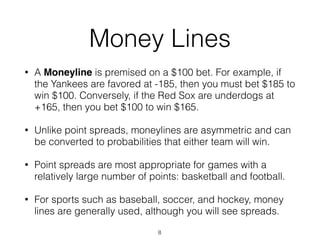
A moneyline bet is the simplest form of wagering: you pick which team will win outright, regardless of score. There is no handicap, no margin to consider—only the final result. Moneylines are expressed as either positive or negative numbers, reflecting the implied probability and potential payout.
Interpreting Moneyline Odds
- Negative moneyline (e.g., -320): The favorite. You must wager $320 to win $100.
- Positive moneyline (e.g., +260): The underdog. A $100 wager returns $260 in profit.
- Even money (+100): A $100 bet wins $100.
The implied probability formula is straightforward:
Applying this to -320 yields approximately 76.2%, while +260 translates to roughly 27.8%. The sum exceeds 100% due to the sportsbook’s vig.
Point Spread vs. Moneyline: When to Use Each
Choosing between a spread and a moneyline depends on your risk tolerance, bankroll strategy, and confidence in the outcome. Each market serves a distinct purpose.
Advantages of Point Spreads
- More balanced odds, typically around -110, offer consistent payout structures.
- Greater value for underdogs who can lose but still cover.
- Reduces the impact of a single dominant player or fluke result.
Advantages of Moneylines
- Eliminates the complexity of margin calculations.
- Ideal for high-confidence picks on heavy favorites.
- Offers substantial payouts on underdogs with genuine upset potential.
For example, betting the Chiefs on the moneyline at -320 is safer but yields minimal returns. Betting the Broncos at +260 is high-risk but offers exponential upside.
The Role of Technology in Modern Betting Markets
Today’s sportsbooks operate on sophisticated platforms that process thousands of data points per second. Machine learning models adjust lines in real time, while APIs feed odds to hundreds of partner applications. For developers and data scientists, this ecosystem presents opportunities in predictive analytics, arbitrage detection, and automated trading.
Understanding point spreads and moneylines is not merely about placing wagers—it is about interpreting probabilistic systems. Whether you are building a betting algorithm, analyzing market efficiency, or simply seeking a sharper edge, these two markets represent the foundational language of sports wagering.
Final Thoughts
Mastering point spreads and moneylines requires more than intuition; it demands an appreciation for probability, risk, and market dynamics. Spreads introduce margin-based complexity, while moneylines distill outcomes to binary decisions. Together, they form the dual pillars of sports betting. As technology continues to reshape the industry, fluency in these concepts will remain indispensable for anyone operating at the intersection of data and sports.
Leave a Reply